
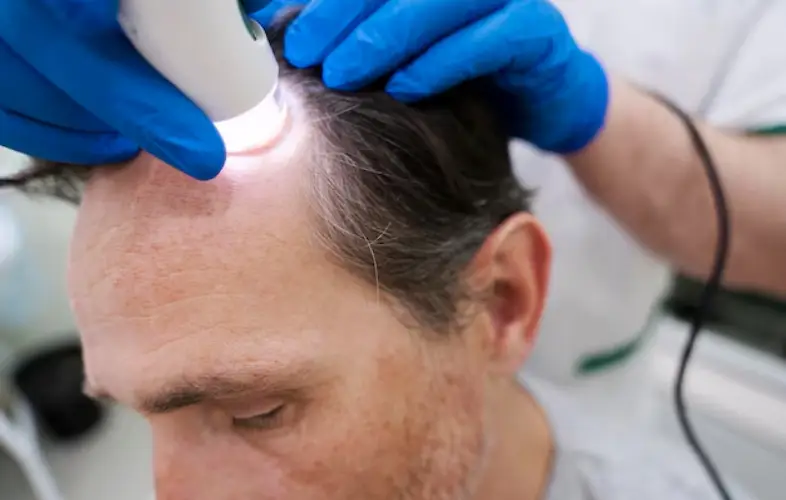
Advanced baldness gradually reveals itself. It starts with hair thinning and ends with little hair growth or bare areas on the top and front of the head. In cases of extensive hair loss, selecting the right hair transplant technique is an absolute necessity, not only for hair regrowth but also for achieving natural-looking, lasting outcomes.
The advanced stage of hair loss demands meticulous planning, harvesting a large number of grafts, and a technique that efficiently maximizes donor hair survival and hair growth. Thanks to evolution in the hair restoration field, solutions are now available for alopecia totalis, alopecia universalis, diffuse alopecia, and widespread hair loss!
Understanding advanced baldness and which hair transplant technique in Gurgaon best suits it can help one set realistic expectations and achieve a confident, satisfactory transformation.
Advanced baldness refers to stages 6 and 7 of the Hamilton-Norwood Scale- the standard classification for pattern baldness. Stage 6 marks the merging of balding of temples and crown, while stage 7 (the most advanced stage) marks hair loss across the entire scalp with only a small band of hair growth around the back and sides of the scalp. It is the result of the dihydrotestosterone hormone, which miniaturizes hair follicles, causes hair shedding, and contributes to a genetic predisposition to pattern hair loss. A hair transplant is the most promising treatment for advanced baldness, performed by a hair restoration specialist.
Choosing the right technique for hair transplant matters as it dictates:
The selection of the best-suited hair transplant technique is made based on the patient’s:
FUT and FUE hold some benefits and drawbacks for the treatment of advanced baldness. Here is the difference that must be known if you can’t decide which technique is best for your case.
| FUT (Follicular Unit Transplantation) | FUE (Follicular Unit Extraction) |
| Traditional technique | Advanced, minimally invasive hair restoration approach |
| Provides high graft yield | Lower graft yield |
| Permanent, linear scarring at the donor site | Minimal scarring (tiny dot-like scars) at the donor site |
| To hide a scar, long hair upkeep is required | Scar hidden under short hair |
| Lengthy recovery (around 2 weeks) | Less downtime (around a week) |
A hair transplant operation involves relocating healthy donor hair from areas resistant to DH-T hormone and genetically induced hair shedding to sparse hair or bare areas of the scalp. The donor area is usually the back and side of the scalp, and the recipient areas are the crown and front of the head.
In case of advanced baldness, getting a hair transplant poses the following challenges:
For natural hairline restoration in advanced alopecia patients, Follicular Unit Extraction is the best option, as it provides the utmost precision and control in placing grafts at specific angles and directions, and allows better graft survival. A micro-FUT is the best for the implantation of finer, single-hair grafts at the very front of the scalp.
A hair transplant can be very challenging in cases of advanced baldness. A suitable candidate should only go ahead with it. Generally, patients with advanced baldness who can choose a hair transplant include:
Often, a FUT hair transplant is the best option for advanced baldness, as it provides the maximum number of donor grafts and is cost-effective in such cases. However, an advanced FUE hair transplant may be recommended later in some cases to refine results or for touch-ups.
Want to determine which hair transplant technique in Gurgaon will best suit you? Consult a skilled hair transplant surgeon, Dr. Shilpi Bhadani, and her team of hair experts at SB Trichology clinic. She is an expert hair transplant doctor and performs various hair loss treatments to manage advanced-stage baldness. During your consultation, the SB Trichology team will conduct a comprehensive assessment of the donor and recipient areas and will discuss your concerns and treatment goals. Probably, you will be recommended for a combination of FUT, FUE, and GFC for satisfactory results.
Request An Appointment
Recent Post

 August 24, 2026

August 20, 2026
August 17, 2026
August 13, 2026
July 08, 2026